Inside Caddix’s Mission to Build a Smarter Cleat for Performance and Protection
For decades, cleat design has treated traction as the ultimate goal. Caddix, founded by CEO Jack Rasmussen, starts…

For decades, cleat design has treated traction as the ultimate goal. Caddix, founded by CEO Jack Rasmussen, starts from a more uncomfortable truth: when a cleat grips too well and the foot gets stuck while the body keeps moving, traction can become the first link in the injury chain. He set out to solve a specific performance problem, a dangerous spike in force during sprinting, cutting, and sudden stops, by rethinking how a cleat interacts with the ground and how that interaction translates up through the foot, ankle, and knee.
The Original Problem: “Traction Can Equate To Injury”
Rasmussen’s frustration came from a simple pattern he saw across all levels of sport, faster, stronger athletes playing on inconsistent surfaces, all wearing cleats that had not fundamentally changed in decades. The traditional formula, stiff plate, rigid studs, maximal bite, creates powerful grip, but it can also lock the foot into the ground in a way the body was never designed to handle. When the studs refuse to release at the right moment, the knee and hip are forced to absorb the rotation and deceleration alone. Caddix was created to reduce that peak load, not by backing off performance, but by managing how and when force is allowed to escape.
A Material Solution Wrapped Around a Mechanical Idea
The first Caddix patent was literally written in a garage, built around the idea that the answer had to be a material solution encasing a mechanical solution, not just a different stud pattern on the same old plate. Instead of treating foam, plastic, and rubber as separate layers, Rasmussen used them as a unified system to control motion, how much a stud can flex, how it compresses, and how it rebounds as the athlete moves. Inside the cleat, a mechanical structure is wrapped in carefully tuned materials so the shoe can behave more like a suspension system than a rigid spike board. That encased mechanism lets the studs grip firmly when an athlete drives, then subtly yield when rotational or braking forces get too high, bleeding off stress before it reaches vulnerable joints.
Designed By Asking, “Why do you hate cleats?”
Caddix did not start with a lab chart; it started with a blunt survey: “Why do you hate cleats?” The answers were brutally consistent. They are too narrow and crush the forefoot. Some are so flexible they feel unstable under load. Padding is minimal in the places that hurt most. And despite all that, many cleats are still oddly heavy for what they deliver. Rasmussen treated these complaints as a mandate, not background noise.
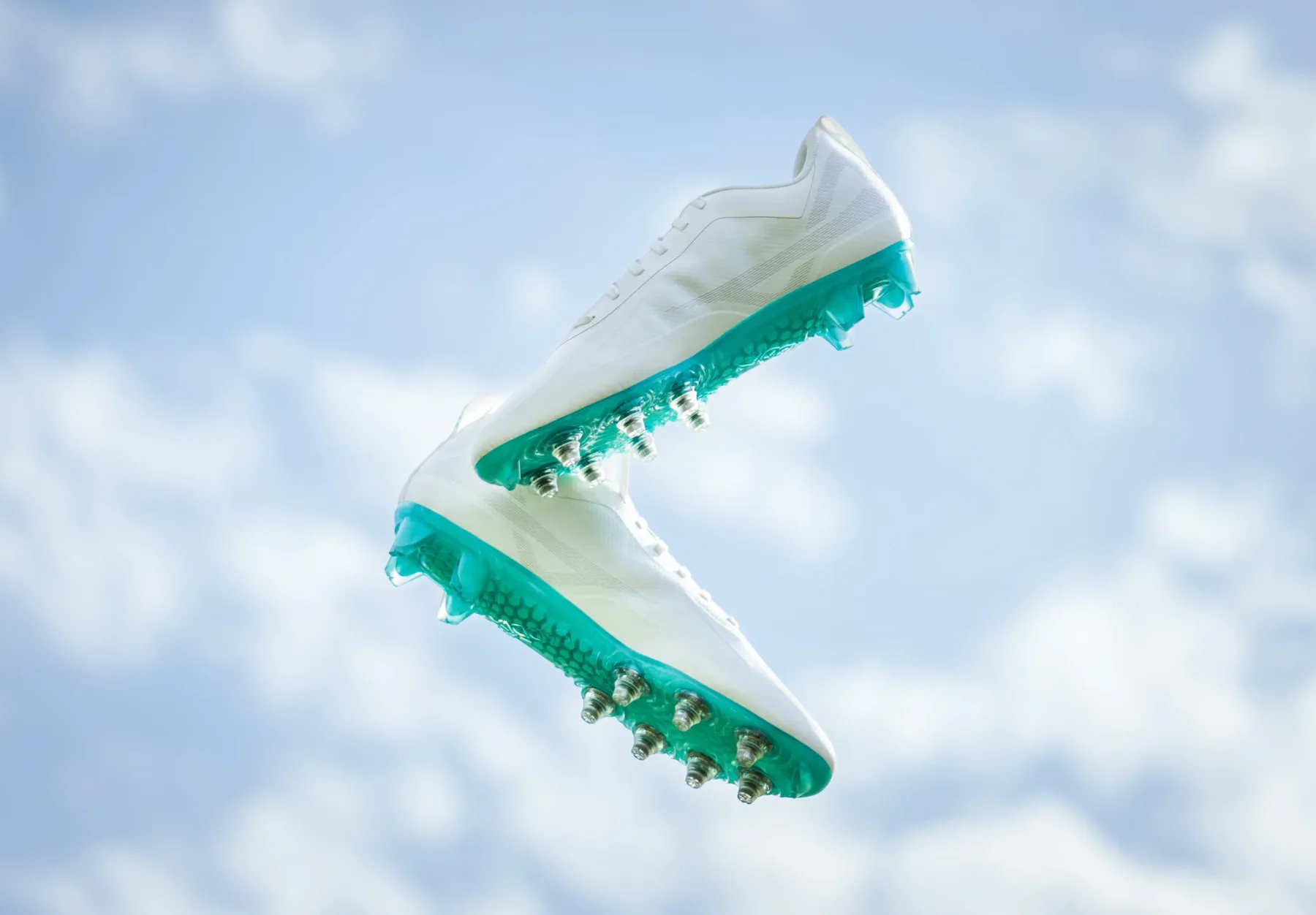
“Every design decision we made started with the athlete’s experience. Players told us their feet hurt, their knees felt beat up, and they were tired of choosing between comfort and performance. We built Caddix to challenge the idea that those tradeoffs are inevitable. A cleat should work with the athlete’s biomechanics, not against them.” said Rasmussen.
One of the most important moves was designing around women’s feet from the outset, wider forefoot, more secure and wider heel, and higher arch support, rather than shrinking a men’s last and changing the color. That geometry gives more surface area under the foot, more stability in high impact movements, and a fit that does not require a painful break in period that athletes have been told to accept as normal. On top of that, Caddix loads the interior with meaningful padding, turning cushioning into part of the performance system so feet, ankles, and knees do not feel stiff and beaten up at the end of a game.
How Caddix Supports Real World Biomechanics
On the field, the Caddix cleat is built to support the way athletes actually move, not just how they look in a straight line sprint test. During acceleration, the tuned plate and encased stud system channel force efficiently into the ground, while the materials manage impact so the foot does not feel like it is slamming into a rigid shell every step. When an athlete cuts or comes to a sudden stop, the studs are designed to flex and adapt to the direction of force instead of acting like immovable pegs. That controlled give reduces the stuck foot effect that can overload knees and hips.
The wider base and heel, combined with a higher arched interior, help keep the foot centered and supported, so players are not fighting their own shoes to maintain alignment. The net effect is a cleat that still delivers serious traction, but with a more forgiving, efficient path for force to travel, one that respects how the body wants to move under stress.
Injury prevention as a core function, not a tagline In today’s game, non contact lower body injuries are a concern from youth leagues to the pros, and Caddix is built with that reality at the center. Rasmussen views the cleat as a true piece of equipment, no different in importance than a helmet, responsible for handling thousands of foot strikes per game. Instead of accepting that the athlete’s knees and ankles will take the hit, Caddix is engineered to take more of that punishment itself.
Built For Inconsistent Fields and Modern Training
Modern athletes rarely play on the same perfect surface twice. One week it is soft grass, the next it is old turf, the next it is a hybrid field with patches of everything. Caddix designs for that reality. The studs are engineered to flex and adapt to different surfaces, moderating the severe traction events that happen when rigid studs overbite into the ground. That adaptability helps maintain the balance between enough grip to perform and enough release to protect.
Rasmussen also sees where training is headed such as heavy linear work, speed programs, and force driven drills that amplify every weakness in footwear. We are asking our bodies to do more, 10,000 foot contacts in a game is not unusual, yet many cleats are still treated as commodity gear. Caddix is positioning its cleats as foundational equipment for this new era, tools that can actually give athletes an advantage by managing force smarter, not just making them feel faster in the first five steps.
From Afterthought to Advantage
In Rasmussen’s view, most players today are wearing footwear designed as an afterthought. The normal experience of painful break in, sore feet, and stiff knees is a sign that cleats have not been keeping up with the demands of modern sport. Caddix exists to flip that script. By starting with the injury and comfort problems athletes actually feel, wrapping a mechanical solution in a sophisticated material system, and treating the cleat as essential equipment rather than a fashion SKU, Caddix is betting that the next era of performance will be defined at ground level, under the athlete’s feet.
“The cleat is the first point of contact between an athlete and the ground, and it has a direct influence on performance, comfort, and long-term health,” said Rasmussen. “Our goal has never been to build just another cleat. It’s to rethink what athletes should expect from the equipment they trust every time they step onto the field.”